
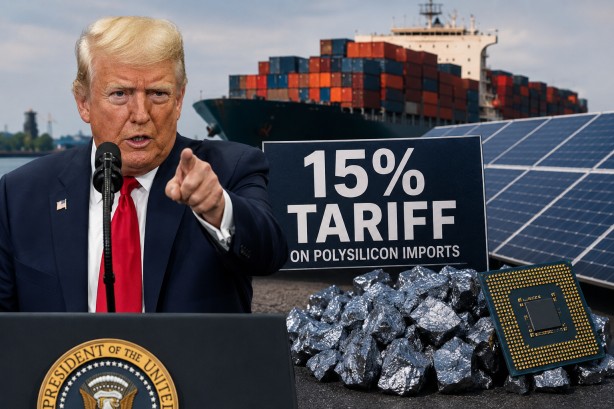
In a decisive move to bolster domestic industries, US President Donald Trump has announced a 15% tariff on imports of products made with polysilicon, a crucial material in the semiconductor and solar panel industries. This tariff, set to be implemented on December 4, aims to diminish the United States’ dependence on China for this vital resource. Polysilicon, an extremely pure form of silicon, is essential for manufacturing semiconductors that drive advanced technologies such as artificial intelligence and data centers, as well as solar cells and panels. Currently, China stands as the dominant global producer of polysilicon.
The new tariff regime includes specific pricing measures: a minimum import price of $21 per kilogram for polysilicon, $100 per kilogram for polysilicon ingots and wafers, $0.22 per watt for solar cells, and $0.38 per watt for solar modules and panels. According to the US administration, these actions are designed to enhance the competitive edge of domestic polysilicon production, thereby ensuring the robustness of critical supply chains that are vital to the nation’s economic and national security.
China has expressed opposition to the US’s latest trade measures, charging the administration with exploiting national security concerns to curtail the operations of Chinese businesses. Beijing has warned that such protectionist policies could lead to disruptions in trade relations between the two economic giants. Meanwhile, the US maintains its focus on reducing reliance on imports, particularly in areas linked to high-tech manufacturing.
Presently, the United States hosts two major polysilicon production plants, managed by Hemlock Semiconductor in Michigan and Wacker Chemie in Tennessee. In addition to implementing tariffs, the new policy framework allows the US government to introduce incentives for companies investing in domestic production of polysilicon and related technologies. This strategy is part of a broader agenda to secure the manufacturing capabilities necessary for strategic industries.
This policy shift comes at a time when China is experiencing robust growth in its export sectors, especially in electronics and products related to artificial intelligence, underscoring its stronghold in high-value manufacturing. By reinforcing domestic production, the US aims to safeguard its technological industries against potential supply chain vulnerabilities and strengthen its economic stance in the global market.